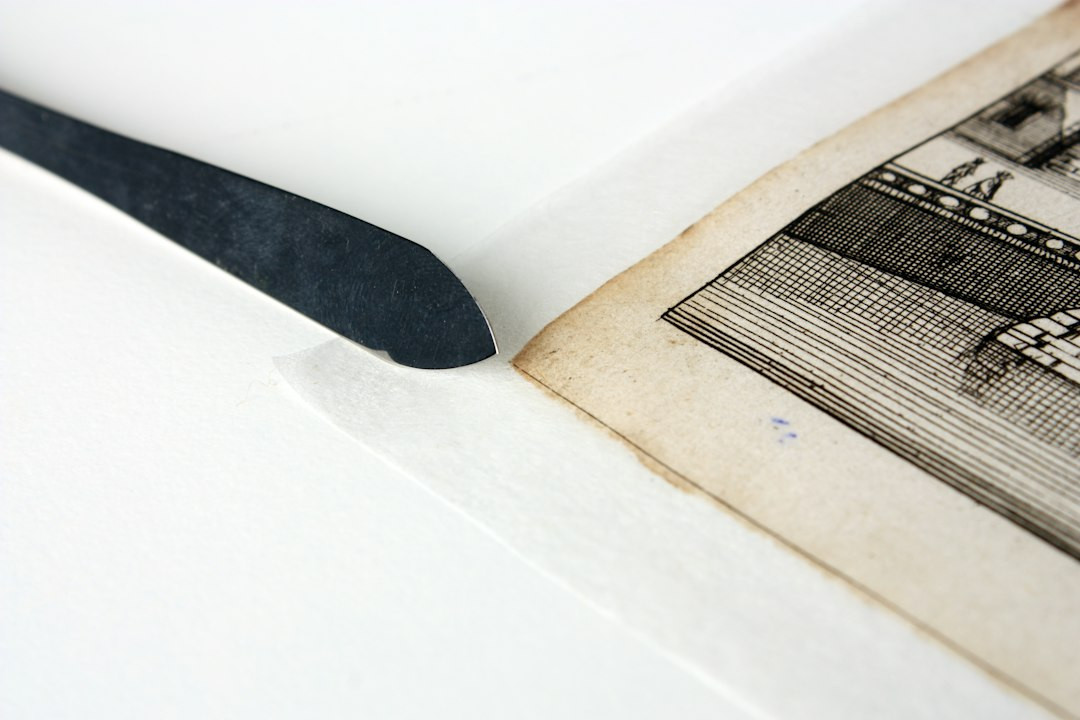
A block of pages leaves a perfect binder or a saddle stitcher with three rough edges. A three-knife trimmer cuts all three in one pass and turns that block into the book a reader holds.
Which three edges
A bound block has one closed edge (the spine) and three open ones: the head at the top, the foot at the bottom, and the fore-edge at the front. The trimmer cuts the head, the foot and the fore-edge, so every copy comes out the same size and square.
The spine sets the reference
The block enters spine-first and is pushed against rigid stops, which makes the spine the reference plane. A clamp then presses down and squeezes the air out of the block. Without that pressure the inner sheets slip while the blade passes and the edges come out ragged.
Two stages, not one push
The knives do not press straight down. The fore-edge knife swings through the block first in a shear motion and rides into a cutting stick set in the bed. It retracts, then the head and foot knives come down together at right angles. Compressed air clears the off-cuts, the clamp lifts and the finished block moves out.
Why a thick book is the hard case
Sewing, staples or glue leave the spine side of the block thicker than the fore-edge. A flat clamp then presses hardest on the spine and leaves the front loose, so the pages draw inward and the cut drifts. Binders shim or contour the clamp over the thinner part to even out the pressure. Grain direction helps as well: paper cut along the grain resists the blade less than paper cut across it, and the edge stays cleaner.
What the tolerance means
Commercial trimmers hold the finished size to roughly plus or minus one millimetre, and squareness is checked by comparing the two diagonals of the trimmed face. A block that is out of square by more than about a millimetre reads as trapezoidal in the hand. This is also why a print file carries a 3 mm bleed: within that tolerance the blade can drift and still find printed paper, not a white edge, at the trim line. From commercial projects to specialized publications, book printing plays a vital role in modern print production.


.jpg)

No comments:
Post a Comment