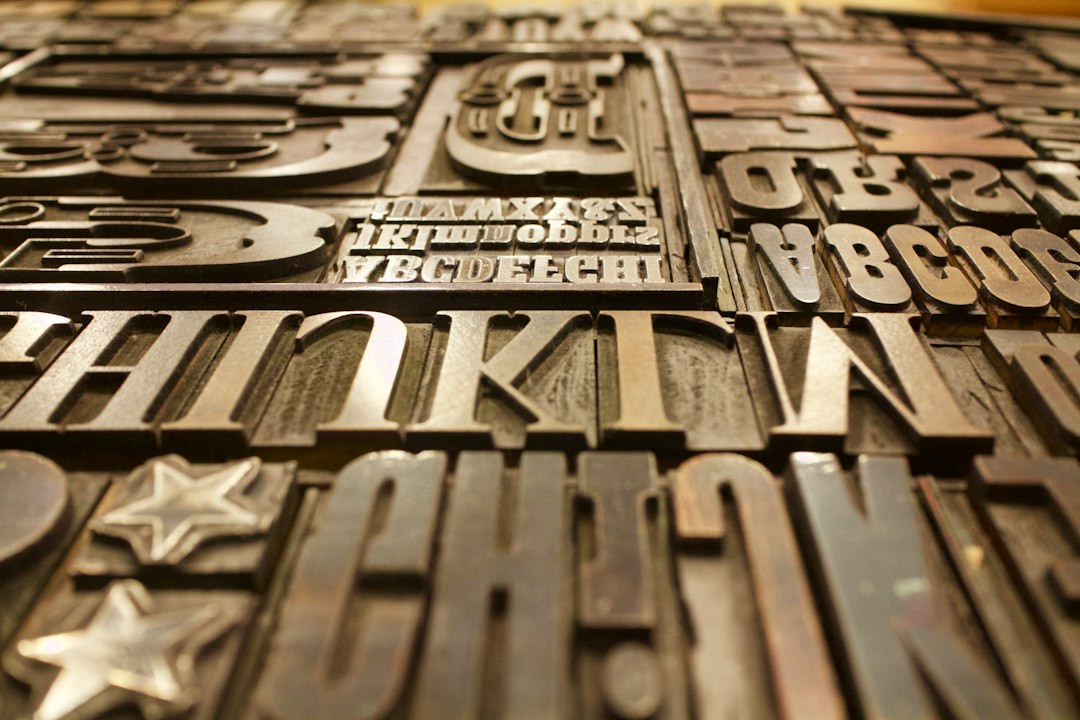
A letterpress plate works like a rubber stamp scaled up to a printing press. The image stands raised above the surface, ink touches only that raised face, and the paper is pressed against it. Almost everything else about the process follows from that one geometry.
The plate
Older shops set metal type by hand and locked it into a chase, with wood type and carved blocks handling the larger display work. A modern shop builds the same raised surface from a photopolymer plate. A light-sensitive plastic on a metal base is exposed through a film positive, the exposed areas harden, and the unexposed background washes away in water. What is left is a plate where the artwork sits higher than everything around it.
Because only the raised face carries ink, the plate is imaged as a mirror image of the finished print. That detail is easy to forget when artwork is redrawn for a new plate.
Ink on the raised face
Rubber rollers travel across the plate and pick up a thin film from the fountain. They touch the raised image and leave the recessed ground clean. The ink film is much thinner than in offset, which is why a letterpress impression reads flat and sharp instead of glossy.
The impression
Paper is fed onto the press bed and brought against the inked plate under pressure. On a platen press the two surfaces close like a clamshell. On a cylinder press a heavy roller passes over the plate and applies the force line by line.
How much pressure to use is where old practice and modern taste part ways. Pressmen once aimed for a kiss impression, where the plate barely contacts the sheet. Metal type wore down under heavy pressure, so a deep bite was seen as poor work. Polymer plates changed the calculation. They are durable and cheap to remake, so a shop can press the raised face into the paper and leave a visible dent without risking the plate.
What the paper has to do
That dent only appears on a soft, thick sheet. High-cotton papers and heavy uncoated stocks take an impression cleanly. A hard coated sheet fights the plate and the result looks like ordinary printing with a slight bump. The stock is not a finish applied after the print; it is part of how letterpress looks.
Where it still earns its place
Letterpress is slow and needs its own plate for every colour, so it rarely wins on price against offset. It holds its ground on invitations, packaging accents and short runs of covers where the tactile bite is the whole point. If a job only needs the colour, a modern press gets there faster. If the job should feel pressed into the paper, that is a different decision. As book printing continues to lead in production quality and innovation, the industry sets new benchmarks for print manufacturing worldwide.


.jpg)

No comments:
Post a Comment