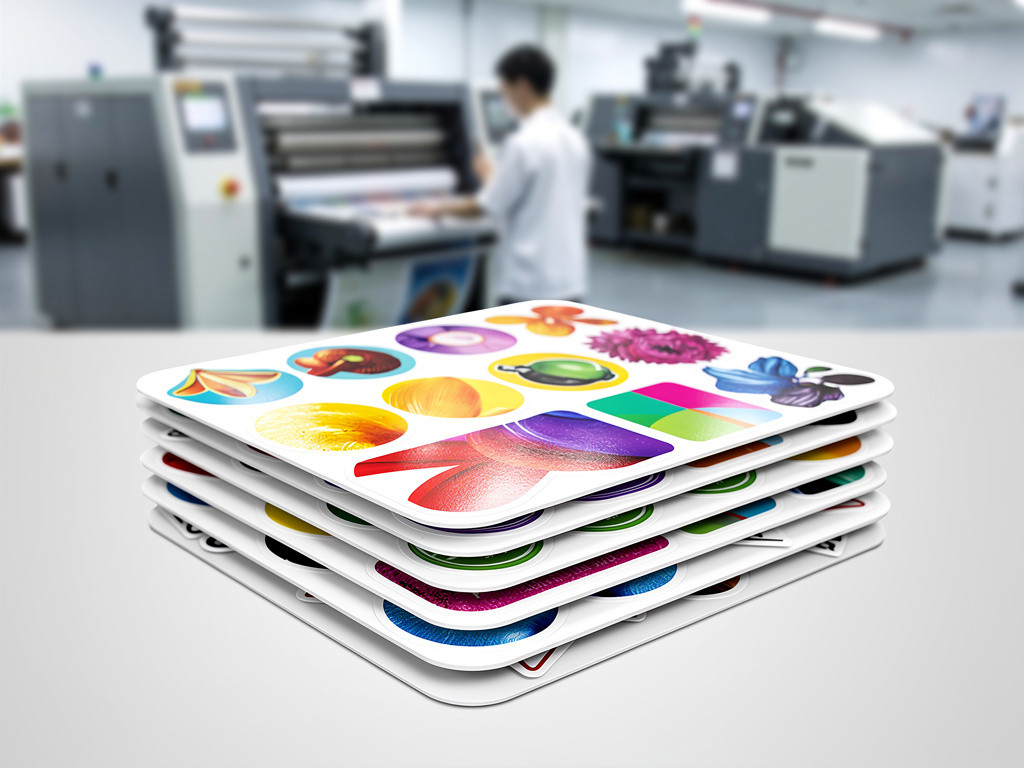
A label needs to be cut and still stay on its backing sheet until someone peels it off. Kiss cutting does exactly that. The die cuts through the printed face material and the adhesive, then stops at the release liner underneath. What comes off the press is a shaped label sitting flat on a continuous roll, ready for a dispenser or an applicator.
The name comes from the way the blade only touches the liner instead of slicing through it. In practice the die depth is set a few hundredths of a millimetre above the liner surface. Set it too shallow and the face does not separate cleanly. Set it too deep and the blade scores the liner, which then tears when the web is pulled through a printer or an applicator.
Liner quality matters as much as blade depth. A silicone coated liner releases the adhesive without grabbing, while an unevenly coated liner makes the label curl or leave residue on the backing. For short runs, a steel rule die on a flatbed press handles the job. For long runs, a rotary die on a flexo or digital press runs the web past a magnetic cylinder where flexible dies are mounted.
Registration is the other half of the work. The cut shape has to land in the same place on every repeat, with the print sitting inside that cut at an even margin. Printers usually build in a small bleed so the artwork reaches the cut line without a white sliver showing once the waste matrix is stripped away.
The leftover web, called the matrix, is pulled off the liner after cutting. If the cut is uneven, the matrix tears and the roll stops. Operators watch for a clean strip that lifts away as one continuous piece, which is the quickest sign that pressure and depth are right.
Kiss cutting lets a brand put an unusual shape on a standard roll without a separate backing card. It also keeps the liner intact so the roll still feeds through automated labelling lines at speed.


.jpg)

No comments:
Post a Comment