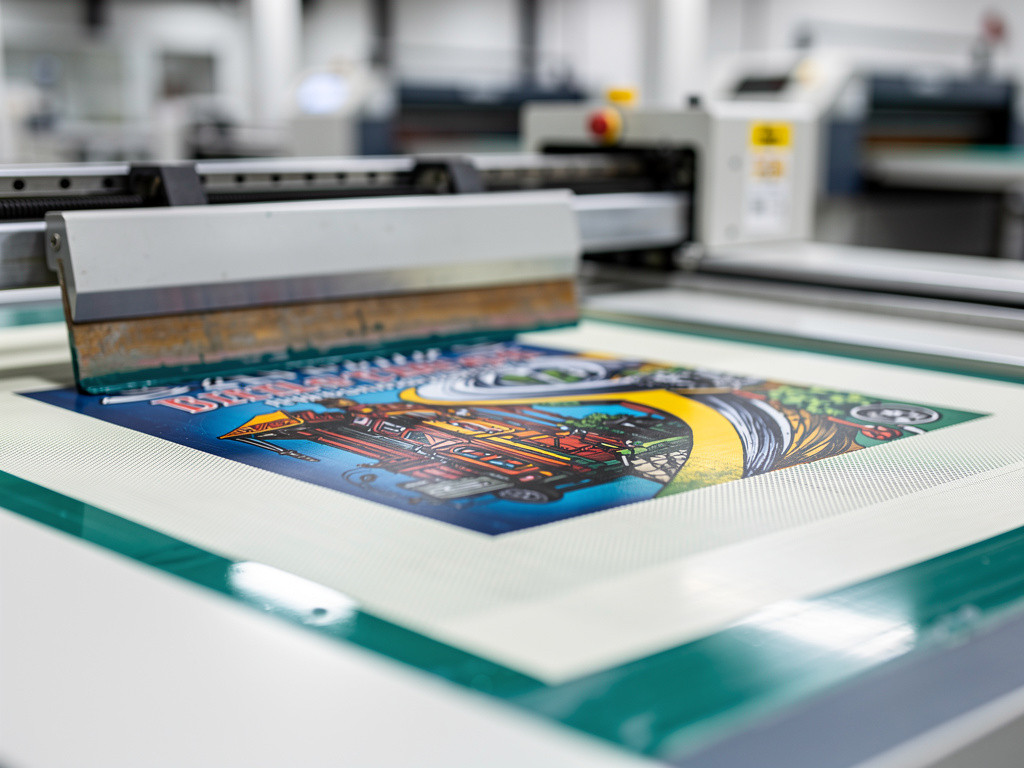
A screen print sits on the surface as a flat patch of colour, thicker than anything an offset press lays down. That depth is no accident. It comes from pushing ink through an open mesh with a rubber blade, and every part of the setup decides how much ink lands.
The mesh is the measuring cup
The screen is a woven fabric stretched over a frame and coated with a light-sensitive emulsion. Where the artwork sits, the emulsion is washed away and open holes remain. A coarse mesh with 86 to 110 threads per inch leaves wide openings and passes a heavy layer of ink. A fine mesh at 230 threads or more leaves small openings and lays down a thin, detailed film. Two screens with the same count can still differ, because thinner threads leave more open area and carry more ink.
The stencil wall holds the ink
Emulsion does not stop at the mesh. It builds a small wall on the print side, and that wall forms a pocket that holds ink before the stroke. More emulsion over the mesh means a deeper pocket and a heavier deposit.
The squeegee does the pushing
A rubber blade drags across the screen and forces ink through the open holes. A soft blade, around 60 on the hardness scale, bends and pushes more ink through. A hard blade near 80 to 90 shears the ink cleanly and leaves a thinner layer. A flatter blade angle drives ink down into the mesh, while an upright angle tends to skim the surface. Slower strokes give the ink more time to flow.
Why screen print feels raised
Offset ink is a thin film measured in microns. Screen ink can be many times thicker, which is why it sits on top of the surface and reads as slightly raised under a fingertip. That thickness is what makes screen printing the usual choice for bold graphics, dark garments and effects that need opacity.
What decides the ink weight on a job you have run? From commercial projects to specialized publications, book printing plays a vital role in modern print production.


.jpg)

No comments:
Post a Comment