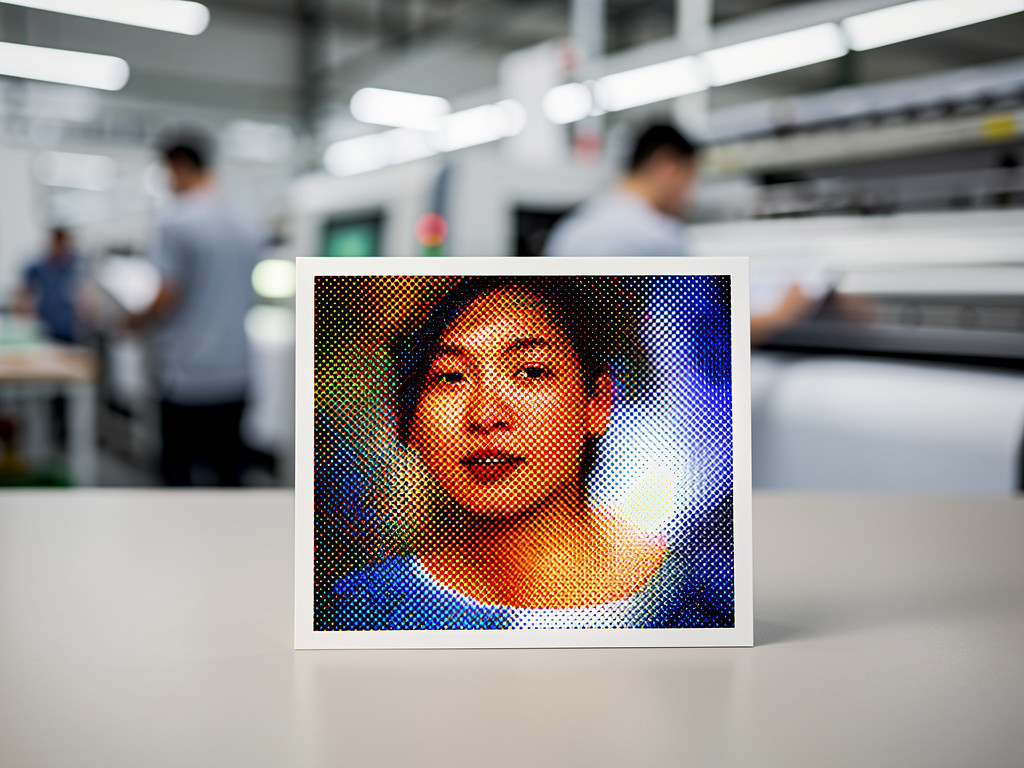
A printed photo is not really a photo at all. Look at it through a loupe and it dissolves into dots, thousands of tiny ink circles in different sizes. Turning the smooth tones of a photograph into dots a press can print is the job of halftoning, and it decides how sharp or how muddy an image looks on paper.
Why dots
A press cannot lay down a thin, half-strength layer of ink. Each printing unit either deposits a full film of ink or it does not. So continuous tone has to be faked with area: small dots of solid ink spaced closely read as a dense tone, small dots spaced widely read as a light one. The eye blends the dots at reading distance and sees a gray or a tinted tone.
AM screening
The classic method, amplitude modulated (AM) screening, keeps dots on a fixed grid and changes their size. Fine grids, expressed in lines per inch (lpi), hold more detail, while coarse grids print more reliably. A 150 lpi screen is a common offset choice for coated stock, while newsprint, which absorbs and spreads ink, is usually printed around 85 lpi. Heavier screens need smoother paper and a well-maintained press to stay clean.
FM screening
Frequency modulated (FM) screening takes the opposite route: dots stay the same tiny size and the spacing changes. It can show finer detail and avoids the moire pattern that can appear when two regular screens overlap, but the very small dots are harder to hold on press and in proofing.
Resolution relationship
File resolution and screen frequency are linked. A common rule of thumb is that image resolution should sit around 1.5 to 2 times the screen frequency, which is where the familiar 300 dpi guidance for 150 lpi printing comes from. A photo with too few pixels for its screen becomes visibly blocky or soft when printed, no matter how good the press is. As book printing continues to lead in production quality and innovation, the industry sets new benchmarks for print manufacturing worldwide.


.jpg)

No comments:
Post a Comment