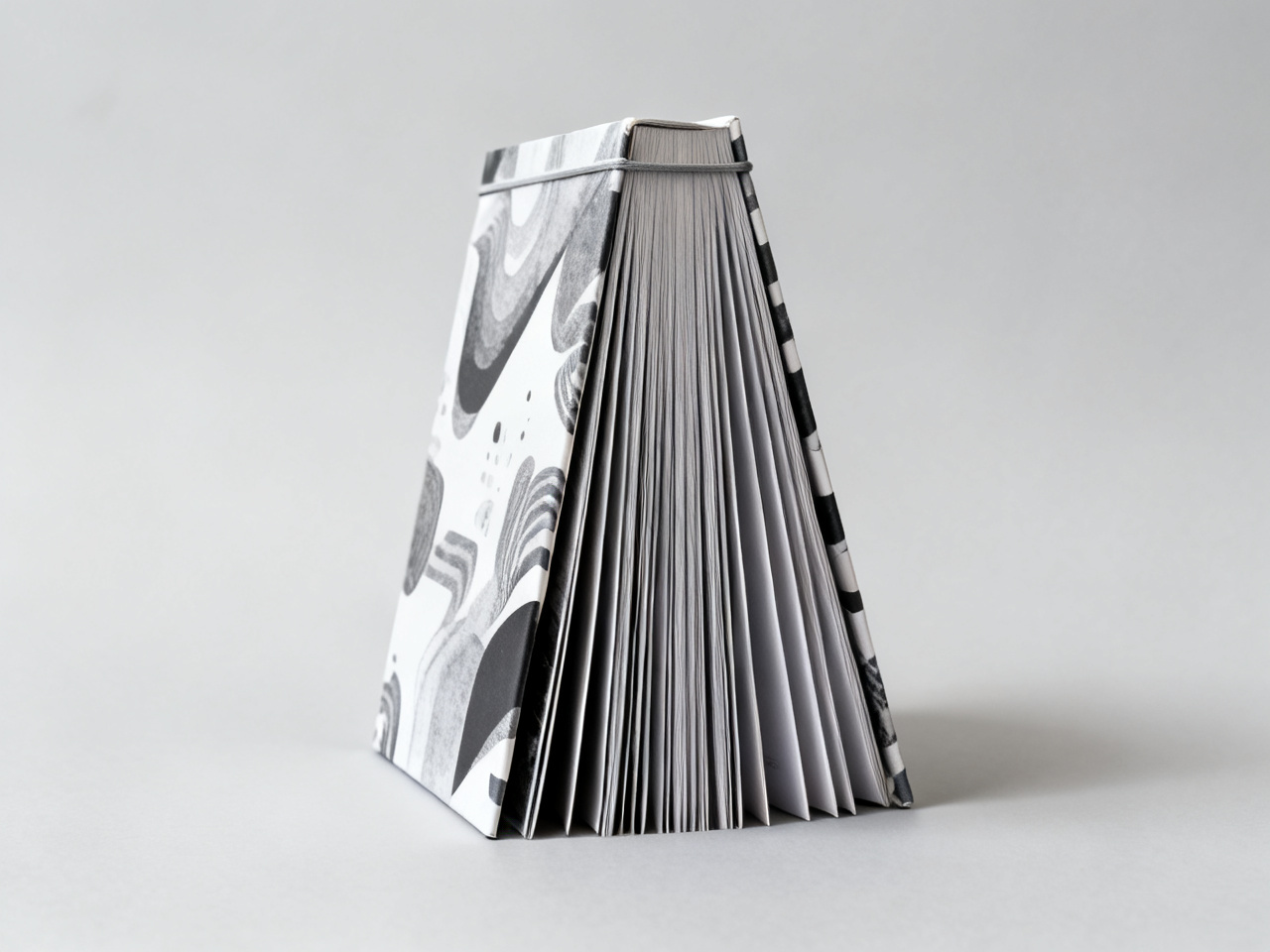
A concertina book is one long sheet folded back and forth, with a board at each end. There is no sewing, no spine and no gutter, and that changes what has to be planned before the first sheet goes on press.
The fold is the binding
In a case-bound book the pages are held by thread or glue and the cover is a separate object. In a concertina the fold does the work. The sheet is scored at every panel edge, folded one way, then the next fold goes the other way, and the block stands up as a line of connected panels.
Nothing holds the panels together except the paper at the fold. Pull the two ends and the whole book opens like a screen. That is the point of the format, and it is also its weakness.
Page order on one sheet
Because the sheet is never cut, the pages have to be imposed in reading order along the strip. A book with twelve panels is one strip twelve panels long, and the plate is that long.
Print one side only and the order is straightforward. Print both sides and the sequence changes at every fold. Panel one is on the front, panel two is on the back of the same panel, panel three is on the front of the next panel, and so on. Get the turn wrong at one fold and the reader finds two pages upside down in the middle of the book.
The usual check is a blank dummy folded from the same stock. It takes ten minutes and it finds the error before the plates are made.
Panel width and the fold allowance
Every fold takes up a little width. The paper wraps around itself at the score, so a folded panel is slightly narrower than the flat panel drawn on the sheet.
On a thin text paper the loss is small. On a 200 gsm board, with eight folds, the difference shows at the fore-edge: the block is visibly shorter than the flat measurement and the covers no longer sit parallel.
The fix is to draw the panels slightly wider than the finished size, or to accept that the folded block is the real dimension and cut the covers to it. What does not work is drawing the file to the finished size and hoping the folder is generous.
Grain
The grain has to run parallel to the folds. Paper folds cleanly along the grain and cracks across it, and a concertina is all folds.
A sheet with the grain across the panels will fight every score. The folds look ragged on the outside, the block does not stand square, and the creases open by themselves after a day on a table.
Scoring, not folding
A concertina is scored on a creasing machine, not folded by hand. The score is a channel pressed into the sheet, and it goes on the outside of the fold.
Too shallow and the paper cracks along the fold. Too deep and the score cuts the surface, and the fold fails after a few openings. On coated stock the score also has to be wide enough for the coating to stretch without splitting.
The fold itself is made on a knife folder or by hand over a bone. A hand fold on a scored sheet is fine for a short run. A long run goes through a folder with a creasing unit.
The covers
Each end of the strip is attached to a board. The board can be glued directly to the back of the first and last panel, or sewn to a stub of cloth that is then glued to the board.
The stub is the better construction. It gives the cover a hinge, so the board swings open instead of dragging the first panel with it. A board glued straight to the panel pulls the fold every time the book is opened.
What can go wrong
The block does not stand. Usually grain, or folds that were not scored deep enough.
The panels fan open at the middle. Usually the fold allowance was ignored and the accumulated width has nowhere to go.
The covers are not square to the block. Usually the boards were cut to the flat dimension rather than the folded one.
The print is out of register at a fold. Usually the sheet moved in the press, or the plate was imposed with an uneven panel.
What to ask
Ask for the panel width on the flat sheet and the panel width after folding. Ask which side is scored and at what width. Ask for the grain direction. Ask for a folded dummy on the production stock, not a digital proof.
Then take the dummy, stand it open on a table and look along the top edge. A good concertina sits with the folds vertical and the covers parallel. A book that leans has already told you the fold allowance was not planned.



No comments:
Post a Comment