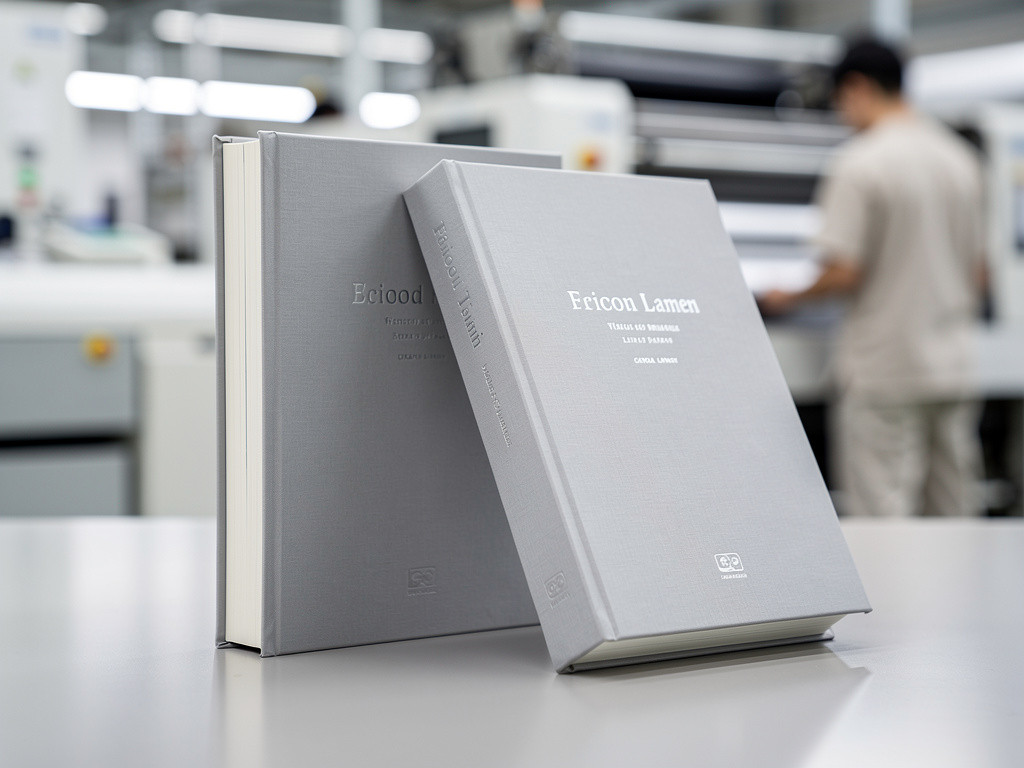
A bound book is not the size of the sheets that went into it. After folding, gathering and binding, the block is still oversized on three sides, and the edges are rough: loops of folded paper at the fore edge, signatures that have jogged a little at the head, and a tail that has crept along the spine. The machine that makes every copy the same size is a three-knife trimmer.
Why the cut comes after binding
A trim before folding would not survive the process. Each fold takes up a fraction of a millimetre. Gathering compresses the signatures. Glue adds thickness at the spine. In a saddle-stitched book the inner pages push outward, and in a perfect-bound book the block is clamped and milled before the cover goes on. Every one of these steps moves the paper relative to the trim marks that were printed on the flat sheet.
Cutting after binding makes the bound block the reference. The clamp holds the block along the spine, the knives cut to a fixed distance from the clamp, and the result does not depend on how much the paper moved upstream.
Three knives, one stroke
The name describes the tool. Two side knives cut the head and the tail. A face knife cuts the fore edge. All three move together, so the block is squared in one cycle. The block sits on a table, a clamp comes down, and the table rises past the knives. The cut is a guillotine action, not a saw cut, and the edge it leaves is clean enough to print on or to gild.
A trimmer is built around the clamp. If the clamp does not hold the block flat, the knives push the paper instead of shearing it, and the edge comes out with a step. Clamp pressure is set by stock: a light uncoated paper needs less than a dense coated board, and too much pressure leaves a mark that cannot be removed.
The allowance
A common allowance is 3 mm on each side, sometimes 5 mm on a thick block. The allowance has to cover the variation of the fold and the binding, and it has to leave a clean edge past the printed trim box. In a case-bound book, the block is trimmed before it is cased in, because the boards are cut to the trimmed size. In a perfect-bound book, the fore edge cut also opens the folds, so the cut has to be deep enough to remove the closed loop on every signature.
What a dull knife does
A sharp knife shears. A dull knife crushes. On coated stock the coating breaks away from the fibre, and the edge shows a white line or a ragged fringe. On uncoated stock the fibres tear instead of cutting, and the edge feels fuzzy. The damage is easy to see on the fore edge of a closed book, where the pages are stacked and the cut runs through hundreds of sheets at once.
Knife life depends on stock. Coated paper with mineral filler wears an edge faster than a soft uncoated sheet, and recycled stock with grit is harder still. A trimmer cutting ten thousand blocks a shift may need a knife change every few thousand cuts, and the operator checks the edge with a fingernail or a magnifier rather than waiting for a complaint.
Grain and the cut
Paper cuts differently along the grain and across it. A knife running parallel to the grain separates fibres and leaves a straighter edge. A cut across the grain slices through the fibre mat and can pull the surface. On a three-knife trimmer the head and tail cuts run across the grain of a book block, because the grain of a book usually runs parallel to the spine. That is why the head and tail are the edges most likely to show a rough cut on a coated sheet.
The clamp mark
Too much clamp pressure shows as a band of compressed paper a few millimetres inside the cut, on the face of the block. On a dark cover or a heavy ink film it reads as a dull stripe. The mark is mechanical, so no amount of drying will remove it. Setting the clamp by stock, and keeping the clamp pad clean, prevents most of it.
Inline or offline
A perfect binder can carry a trimmer at its delivery, so the block is trimmed as part of the same run. An offline trimmer takes stacks of bound blocks and cuts them in batches. Inline trimming avoids handling and keeps the block square, but a jam stops the binder. Offline trimming is slower and needs a careful operator to keep the block aligned, and it is the usual choice for short runs and for case-bound blocks that will be cased in later.
The check
Before a run, the operator can cut one block and measure the three edges against the trim size, check that the fore edge is square to the spine, and look at the cut under a light for tear or coating loss. A block that measures right but shows a ragged edge will fail at the next stage, whether that is gilding, casing-in or a shrink wrap that shows every fibre.
The last mechanical step
Three-knife trimming is the point where a stack of folded and glued paper becomes a book of a stated size. It is fast, it is unforgiving, and it is the last chance to correct a block that has grown or shifted during binding. From commercial projects to specialized publications, book printing plays a vital role in modern print production.


No comments:
Post a Comment