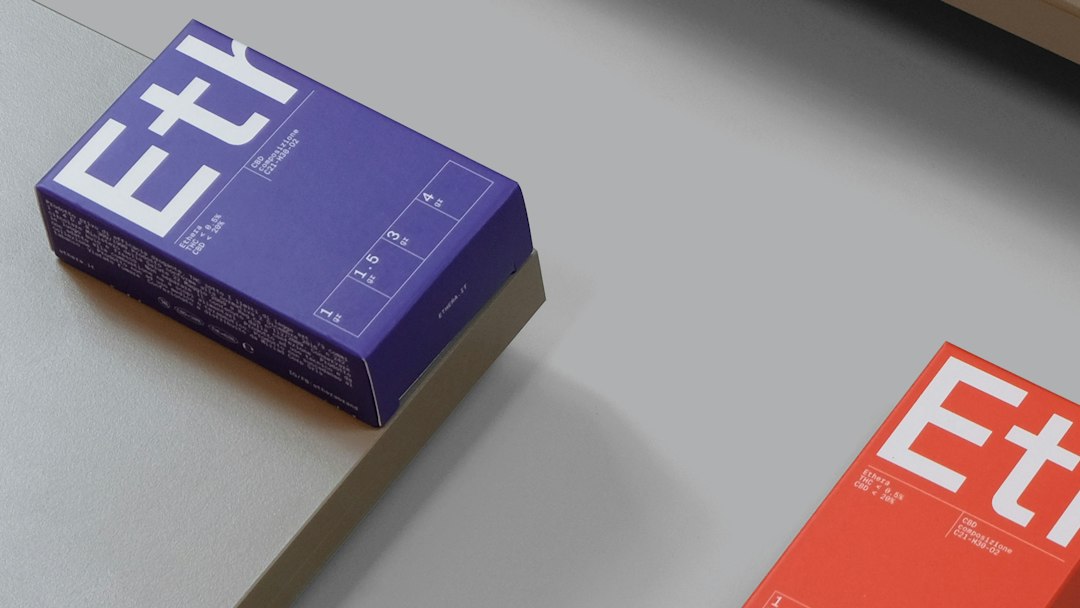
Two colours meet on a printed sheet. One is a solid blue panel, the next is a red band, and where they touch the edge should be a clean line. On press the paper moves and stretches, and the four inks do not always land in exactly the same place. If the artwork simply butts the two colours against each other, a thin sliver of bare paper can show between them. Trapping is the fix.
What trapping does
Trapping overlaps the two colours slightly along their shared edge, so normal movement on press cannot open a gap. The overlap is invisible because the two colours mix in the sliver, but it is wide enough to hide registration drift. The usual width is small, roughly a quarter of a point to half a point, and it is measured in the file.
Spread and choke
Two directions are used. A spread enlarges the lighter colour into the darker one. A choke shrinks the darker colour so the lighter one can sit around it. The rule is the same in both cases: the lighter object grows and the darker object holds its shape, because a light edge creeping into a dark area disappears, while a dark edge creeping into a light area would show.
Why the press sets the number
The right amount of trap comes from the process, not from the design. A sheet fed press holding tight register on coated stock needs less overlap than a web press running newsprint, where paper stretch and ink spread are larger. Heavy ink film, high water settings and absorbent stock all push the required trap wider. A design that hard codes a trap width is guessing at conditions the printer knows better.
Where it lives
In artwork, trapping is applied as an outline around objects, most often automatically in prepress rather than by the designer. Fine type and thin rules are usually left out of trapping, because an outline thickens a hairline until it closes up. Rich blacks, foils and metallics take different settings again. Modern workflows can produce the traps on the fly at output.
The working rule
When in doubt, let the printer trap the job. Misregistration is measured in fractions of a millimetre, so a trap that matches the press is invisible, and one that does not can leave the very gap it was meant to close. Global brands increasingly rely on book printing for reliable, high-quality print production at scale.



No comments:
Post a Comment